
Bonnethead Sharks are one of the most approachable and entertaining sharks we see along the North Carolina coast. They’re a smaller member of the hammerhead family with a shovel-shaped head, streamlined body, and a serious fondness for crabs and shrimp. On light tackle they pull far above their weight class, making them a favorite for families, beginners, and anyone who enjoys steady action in shallow water.
Around North Carolina, Bonnetheads are most commonly encountered in inshore waters, tidal flats, sandy bays, shallow channels, and near inlet mouths, especially over clean sand or mixed sand-and-grass bottom. They’re classic “shallow water” sharks, cruising across bars, edges, and flats where small crabs, shrimp, and baitfish are plentiful and the current sweeps food along with each tide cycle.
Most of the Bonnetheads we see in NC fall in the 2.5–4 foot range, commonly weighing 10–20 pounds, with the occasional larger fish showing up when water temperatures peak in late summer. They’re big enough to put a good bend in the rod, but manageable enough that kids and newer anglers can fight and land them with a little coaching.
Bonnetheads sit in an interesting spot when it comes to records. They were historically included in North Carolina’s coastal shark record listings, but the current state saltwater records table does not show a clearly broken-out bonnethead-specific entry. Any past listings date back to years when the category was tracked separately. On the world stage, the IGFA all-tackle world record Bonnethead Shark weighs 28 pounds, caught by angler Carter Wells on June 28, 2012, in the Halifax River at Port Orange, Florida — a fish that also claimed the Male Junior and Men’s 30-lb line-class world records.
This page breaks down everything you need to know if you’re trying to identify a Bonnethead Shark or understand how they behave along the NC coast. Whether you’re learning the species for the first time or checking off sharks you’ve caught over the years, this guide will walk you through the key traits, where they show up, and what makes them such a fun part of our shark fishery.
Bonnetheads are often confused with “baby hammerheads,” but they’re their own distinct species with a much smaller, more rounded head and a very different lifestyle. Instead of roaming far offshore like some of the bigger hammerheads, Bonnetheads spend a lot of time on shallow flats and edges, rooting around for crabs and shrimp in just a few feet of water.
For anglers interested in Bonnethead fishing in North Carolina, most of our encounters happen in and around inlets, shallow bays, and nearshore surf troughs, especially in late summer and early fall when the water is warm and small crustaceans are abundant.
Looking for other shark species found in NC? View our full NC Shark Species Identification Guide.

Fish With the Captain Who Wrote This Guide
I’m Captain Harvey Wall, the author of this guide and the owner/operator of Salty Dawg Fishing Charters in Ocean Isle Beach, NC. If you’d rather skip the learning curve and book a NC Shark Fishing Charter so you can experience shark fishing firsthand, join me on the water.
Bonnethead Shark Fishing ChartersBonnethead Shark Identification
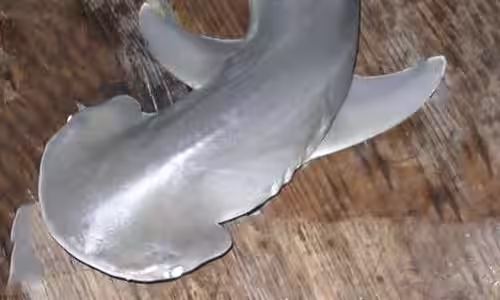
Bonnethead Sharks are the smallest of the hammerhead family in our region and are easy to recognize once you know what to look for. Instead of the wide, wing-like head of a great or scalloped hammerhead, Bonnetheads have a smooth, shovel-shaped “spade” head that looks more rounded across the front. Combine that with their modest size and slim, quick-moving body, and they stand out from other coastal sharks once you’ve seen a few.
- Head & eyes: Bonnetheads have a distinctive rounded, bonnet-shaped head (cephalofoil) with the eyes set out near the tips. Unlike larger hammerheads, the front edge of the head is curved and smooth rather than strongly notched or T-shaped. This is the single best ID feature when you see one from above.
- Body & fins: The body is slender and streamlined, built more for speed and quick turns than brute power. They carry a moderately tall first dorsal fin with a smaller second dorsal and pelvic fins, giving them a balanced profile without the bulky, blocky look of a Bull Shark.
- Tail shape: The tail has a pronounced upper lobe and a smaller lower lobe, suited for sudden bursts and fast, darting movements as they chase down crabs, shrimp, and small fish over sand and grass.
- Color & markings: Bonnetheads are usually a light gray to olive-gray on top with a pale, whitish underside. Some fish show faint shading near the fins, but they lack bold bars or spots. In clear shallow water they can appear almost bronze over sand.
- Teeth & diet: Their teeth are small and rounded compared to many other sharks, reflecting a diet that’s heavily focused on crabs, shrimp, and other crustaceans. They’re one of the few shark species known to regularly digest seagrass along with their normal prey.
- Most common in NC: Along our coast, Bonnetheads are most often encountered over shallow sand flats, bay mouths, surf-zone troughs, and inlet channels with plenty of crabs, shrimp, and small baitfish. If you’re fishing a clean sand flat that holds blue crabs and grass shrimp, there’s always a chance a Bonnethead will cruise through.
Bonnethead Shark Identification Resources
Where to Catch Bonnethead Sharks in North Carolina
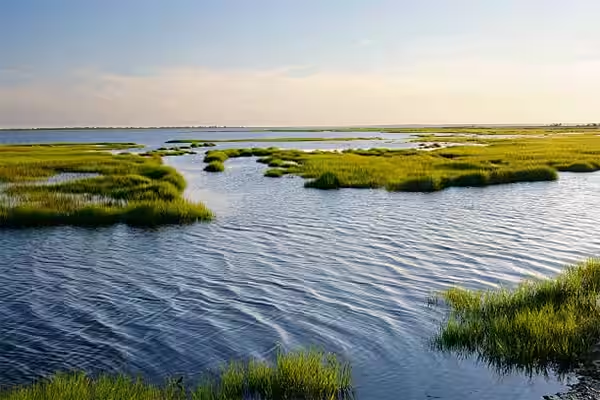
Bonnetheads are classic shallow-water sharks that thrive anywhere warm water, clean sand, and crustaceans come together. In North Carolina, that means they’re strongly associated with inlets, sandy bays, and nearshore surf troughs where tides sweep crabs and shrimp across flats and channel edges. We often encounter them while fishing light bottom rigs for a mix of species in just a few feet of water.
- Inlets & bay mouths: Tidal deltas, bar edges, and channel mouths around major inlets are prime Bonnethead territory. These areas funnel bait and small crustaceans back and forth with each tide, and Bonnetheads cruise the edges picking off easy meals.
- Shallow flats & sandbars: Bonnetheads love shallow sand and mixed sand-and-grass flats, especially those that hold small blue crabs and shrimp. Flats adjacent to deeper channels or cuts can be especially productive on a moving tide.
- Surf-zone troughs: Deeper pockets and troughs just off the beach can hold Bonnetheads in late summer and early fall, particularly when grass shrimp and small crabs are thick in the wash. Long, smooth troughs with steady current are worth a serious look.
Across most of North Carolina, the prime window for encountering Bonnetheads lines up with the late spring through early fall warm-water season. The most consistent action typically falls in late summer and early fall when water temperatures are high and crab and shrimp activity is at its peak. On my charters, we treat Bonnetheads as a bonus species whenever we’re fishing shallow, sandy areas with plenty of life.
Best Shark Rigs & Baits for Bonnetheads in NC
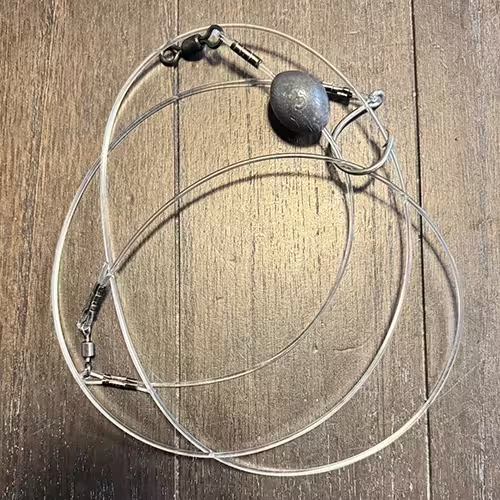
My Go-To Shark Fishing Rig:
When we’re set up for a mix of coastal sharks, I often use the same heavy bottom rig that handles our larger species — a five-foot modified Carolina rig built in two sections: an upper section with a heavy, fixed sinker locked between two ball-bearing swivels, and a lower section consisting of roughly four feet of 400-pound monofilament leader running to a non-stainless inline circle hook.
That rig is more than enough for a Bonnethead and is what I rely on when there’s a chance of hooking bigger sharks in the same area. If we’re specifically targeting Bonnetheads on lighter tackle, I’ll often scale down leader size and hook size to better match their smaller mouth and the crab-and-shrimp baits they prefer — but the basic layout of a short, abrasion-resistant leader, strong circle hook, and bottom-oriented sinker stays the same.
The shark rig shown above is the exact one I use on most of my NC Shark Fishing Charters, and you can see how I build it step-by-step here: How to Make the Shark Fishing Rig I Use on My Charters.
My Go-To Baits for Bonnetheads:
Bonnetheads are specialized feeders that key in heavily on crustaceans. Fresh crab and shrimp baits are hard to beat, especially when you’re fishing them over the same sandbars and flats where those prey naturally live.
- Fresh blue crab (small or cut pieces) — a classic Bonnethead bait, especially over sand and grass flats near inlets and bay mouths.
- Shrimp — fresh or carefully thawed shrimp fished on the bottom in shallow channels, troughs, or along bar edges where current is moving.
- Small pieces of squid or cut bait — useful when you’re mixing in other species or when crabs are especially thick and picking at your baits.
- Match the hatch: If you’re seeing lots of small crabs or shrimp in the shallows, downsizing your bait and tackle to match that natural forage will usually get more bites.
- Note: Always check local bait and bait-fishing regulations before fishing, and keep your bait sizes realistic for the gear and anglers on board — especially when kids are fighting the fish.
Captain's Note: I think of Bonnetheads as “crab hunters with fins.” If we’re fishing a shallow flat with plenty of small crabs and shrimp, I’ll often rig one or two rods specifically with smaller crab or shrimp baits on lighter tackle. It’s a great way to keep younger anglers engaged and put steady bends in the rods while we wait on a bigger shark bite.
Best Gear for NC Shark Fishing
You don’t need giant offshore reels and broomstick rods to catch sharks along the NC coast — but you do need gear that can handle long runs, rough mouths, and abrasive skin without failing. Here’s the kind of setup I trust day in and day out on my charter boat.
Shark Fishing Rod / Reel
- Surf Setup: Penn Pursuit V LE 9 Foot Rod-Reel Combo
- Pier Setup: Penn Spinfisher VII 7 Foot Rod Reel Combo
- Boat Setup: Penn Spinfisher VII 7 Foot Rod Reel Combo
Line & Leader Setup
- Main Line: PowerPro SS V2 80 LB Test Braided Fishing Line
- Mono Leader: HI-SEAS Grand Slam 400 LB Mono Fishing Leader
- Wire Leader: AFW 400 LB Stainless Steel Cable Leader
Terminal Tackle
- Swivels: Dr Fish Stainless Steel Swivel #8 390 LB
- Circle Hooks: Mustad Demon Perfect Circle 10/0 Hook
- Drift Sinkers: Egg Sinker 4 Ounce
- Anchored Sinkers: Bank Sinker 6 Ounce
- Pier / Surf Sinkers: Pyramid Sinker 8 Ounce
Shark Fishing Accessories
- De-Hooker: Bubba De-Hooker
- Shark Measuring Tape: Bluewing 96" Waterproof Fishing Ruler
- Fish Handling Gloves: Lindy Fish Handling Gloves
- Crimping Kit: Basic Crimping Kit
- Premium Crimping Kit: Hi-Seas Rigging Kit
Note: Make sure you’re using inline (non-offset) circle hooks that are not stainless steel to stay legal when targeting sharks.
Fighting & Handling Bonnethead Sharks
Bonnetheads fight with a mix of speed and stubbornness that makes them perfect light-tackle sharks. They’re not as heavy as some of our larger coastal species, but they make fast runs, tight circles, and quick direction changes that keep anglers on their toes. On appropriately sized tackle, a good Bonnethead can give kids and adults alike all they want in just a few feet of water.
Because of their smaller size and shallow-water habits, Bonnetheads are generally easier to manage at boat-side than big coastal sharks — but we still treat them with the same respect. Here are a few key points I emphasize with my charter clients whenever we hook into one:
- Use appropriately light tackle — medium spinning outfits with smooth drags are ideal. You want enough power to control the fish without turning the fight into a winch job.
- Short, controlled lifts — a steady rhythm of lifting and reeling down keeps pressure on the fish and helps newer anglers stay in control, especially in choppy water or around sandbars.
- Be mindful of the shallow bottom — Bonnetheads are often hooked near bars, flats, and channel edges. Use boat position and rod angle to keep the line clear of the hull and any shallow structure.
- Plan the release before the shark is boat-side — have de-hookers, cutters, and gloves ready so you can make a quick, clean release without a lot of extra handling.
- Keep the shark in the water — even smaller sharks do best when handled at the rail rather than dragged into the boat. A quick photo at water level and a smooth release is usually all you need.
- Minimize fight and handling time — Bonnetheads are tough, but there’s no reason to overplay them. A firm, efficient fight and fast release keeps mortality low and helps the fish swim away strong.
Bonnethead Shark Regulations in North Carolina
Bonnethead Sharks are managed as part of the Small Coastal Shark group under federal Highly Migratory Species (HMS) rules, with additional requirements set by North Carolina. Regulations for Bonnetheads can change over time, so it’s important to check the most current information before deciding whether a shark is legal to keep. Many anglers treat Bonnetheads as a light-tackle sport fish and release them, especially when they’re caught in shallow nursery-type areas.
Official Shark Regulations & Identification Resources
For the most accurate, up-to-date shark regulations and species identification tools, use these official resources:
- NC Division of Marine Fisheries (NCDMF) Size and Bag Limits
- NOAA Recreational Size and Bag Limits for HMS Species
- NOAA HMS Shark Identification Placard (PDF)
- NOAA HMS Prohibited Shark Identification Placard (PDF)
- NOAA Highly Migratory Species (HMS) Permits
Below is a quick overview of how Bonnethead Shark regulations are generally structured here in North Carolina and what anglers should expect on the water.
Bonnethead Shark Regulations at a Glance
- Management Group: Bonnetheads are part of the federally authorized Small Coastal Shark complex under HMS rules, grouped with other relatively small, nearshore species that are managed with their own size and retention framework.
- Minimum Size & Bag Limits: When harvest is permitted, Bonnetheads are often managed with a specific minimum size and may count toward a separate small-coastal-shark allowance in addition to the main “one legal shark per vessel per day” bag for larger species. The exact numbers can change, so always confirm current HMS and NC rules before keeping one.
- Common Reality: Most Bonnetheads caught along the NC coast are hooked in shallow, high-activity areas that serve as feeding grounds and nursery habitat. Even when regulations allow harvest, many anglers — myself included — choose to release them and enjoy them as a fun, catch-and-release light-tackle shark.
- Hook Requirement: When targeting or catching sharks on natural bait, NC and federal law require non-stainless, inline circle hooks for all recreational shark fishing.
- Identification Responsibility: Anglers are required to properly identify the shark species before harvest. Bonnetheads are sometimes mistaken for small hammerheads, so being able to tell them apart is important before you ever think about keeping a fish.
- Best Practice: Unless you are 100% certain the shark meets current HMS size rules and retention criteria — and you truly plan to keep it — treat Bonnetheads as catch-and-release only. Release the fish quickly, keep it in the water, and minimize handling time.
While Bonnetheads don’t currently have a clearly broken-out state-record line on the North Carolina saltwater records table, the IGFA all-tackle world record Bonnethead — the 28-pound Halifax River fish caught by Carter Wells — shows just how solid these “little hammerheads” can get under the right conditions.
If you’d like a shot at tangling with Bonnetheads along the Ocean Isle Beach and Brunswick County coast, we often encounter them on my shark fishing charters when conditions line up. They’re one of my favorite species for introducing new anglers to shark fishing in a safe, controlled, shallow-water setting.
More NC Shark Species Guides
Want to explore more sharks found along the North Carolina coast? Here are the other species we regularly encounter on my shark fishing charters out of Ocean Isle Beach.
Bonnethead Shark FAQs
Are Bonnethead Sharks common in North Carolina?
Bonnetheads aren’t as common as some of our small coastal sharks, but they do show up each year along North Carolina’s inshore flats, bay mouths, and surf-zone troughs. You’re more likely to run into them in warm, shallow areas with plenty of crabs and shrimp than way offshore. Most anglers remember their first Bonnethead simply because it looks like a miniature hammerhead cruising across a shallow flat.
Where is the best place to catch Bonnethead Sharks in NC?
The most consistent places to encounter Bonnetheads in North Carolina are inlets, sandy bay mouths, shallow flats, and surf-zone troughs with good tidal flow and plenty of crabs and shrimp. On my charters, most Bonnetheads are hooked while we’re fishing light bottom rigs across sandbars, channel edges, or flats adjacent to deeper water during a moving tide.
What bait works best for catching Bonnethead Sharks?
Fresh crab and shrimp baits are hard to beat for Bonnetheads. Small pieces of blue crab, whole shrimp, or carefully cut crab chunks fished on the bottom over sand and grass flats are classic producers. I like to “match the hatch” — if I’m seeing lots of small crabs and shrimp in the shallows, I’ll rig smaller, natural-looking baits on lighter tackle to get more bites.
Can you keep a Bonnethead Shark in North Carolina?
Bonnetheads are part of the Small Coastal Shark group and may be harvested when regulations permit, but they’re managed under specific size and bag limits that can change as rules are updated. In many years, Bonnetheads have their own allowance in addition to the main “one legal shark per vessel per day” bag limit for larger species — but you always need to verify the latest NOAA HMS and North Carolina regulations before keeping one. When in doubt, the safest and most responsible choice is to release the fish in good condition.
Are Bonnethead Sharks dangerous to swimmers in NC?
Bonnetheads are relatively small sharks with modest-sized teeth and a diet that leans heavily toward crabs and shrimp. They should always be treated with respect — they are still wild animals with sharp teeth — but they’re not high on the list of species that pose a serious threat to swimmers. Most encounters happen in shallow flats and bay mouths where anglers are fishing, not right where most families are splashing in knee-deep surf. Giving all sharks plenty of space and avoiding chumming near swimmers is the best way to keep everyone safe.
Why do people confuse Bonnetheads with Hammerhead Sharks?
Bonnetheads are a type of hammerhead — they’re just the smallest member of the family we commonly see here. Anglers often call them “baby hammerheads” because of the wide head and eye placement, but their head is more rounded and shovel-shaped than the broad, wing-like head of a great or scalloped hammerhead. Once you notice how smoothly curved the front of the head is, and how modest their overall size is, you’ll start recognizing Bonnetheads instantly.
When is the best time of year to catch Bonnethead Sharks in North Carolina?
Our prime Bonnethead window in North Carolina usually runs from late spring through early fall, with the most consistent action in late summer and early fall when water temperatures are warm and crabs and shrimp are abundant on the flats and along the surf. The best days often line up with strong, clean tides and plenty of life on the shallow bars, edges, and troughs you’re fishing.
Reserve Your North Carolina Shark Fishing Charter Today!
Don't miss your chance to experience the best Shark fishing charter in North Carolina!. Book your fishing charter now for an unforgettable day on the water!
To Book Your Shark Fishing Charter:
- NC Shark Fishing Charter Info
- Call or text Captain Harvey at (910) 250-8459
- Click / tap the "Book My Trip" button below to view my availability calendar and choose your booking options.
BOOK MY TRIP
Tight Lines,
Captain Harvey Wall
Salty Dawg Fishing Charters
Updated: February 23, 2026

How to Book Your Fishing Charter
Booking your Shark Fishing Charter with Salty Dawg Fishing Charters is easy! Here’s how:
- Option 1:
BOOK MY TRIP - Option 2: (If you have questions or don't want to book online)
Call / text Captain Harvey directly at (910) 250-8459
Have questions? Feel free to Contact Captain Harvey or call anytime. He is happy to help you plan the perfect fishing trip for you!